CVE-2026-45321 / GHSA-g7cv-rxg3-hmpx. Active since May 11, 2026. 42 TanStack packages (84 versions) directly compromised, plus the broader Mini Shai-Hulud campaign affecting 175 packages across 17 namespaces. Daemonizes silently on
npm install. Harvests GitHub Actions OIDC, AWS, Vault, and Kubernetes credentials. Propagates autonomously. If you run JavaScript anywhere near a developer machine: stop and read this.
| CVE | CVE-2026-45321 / GHSA-g7cv-rxg3-hmpx |
| Campaign | Mini Shai-Hulud |
| Status | Active (May 11, 2026) |
| TanStack scope | 42 packages · 84 versions · 12M+ weekly downloads |
| Broader campaign | 175 packages · 406 versions · 17 namespaces |
| Primary targets | Developer machines, CI/CD runners, cloud workloads |
What happened#
An orphaned commit in the TanStack/router repository was used to hijack the repository’s CI workflow OIDC token. With that token, the attacker bypassed 2FA and npm publishing protections, pushing a malicious payload — router_init.js (2.3 MB) — into affected package versions as a post-install hook.
The infection chain once a developer runs npm install:
router_init.jsexecutes viapostInstallhook- Daemonizes: detaches from the terminal, nothing looks wrong, install appears to complete normally
- Harvests credentials in order: GitHub Actions OIDC tokens, AWS via IMDSv2/Secrets Manager/SSM across all regions, HashiCorp Vault, Kubernetes service account tokens
- Propagates: uses the stolen OIDC token to republish a new malicious version to npm under the legitimate maintainer identity
- Persists: writes hooks to
.claude/and.vscode/directories - Exfiltrates: over Session’s decentralized P2P network (
filev2.getsession[.]org) - Commits to compromised repositories via GitHub GraphQL API, spoofing
claude@users.noreply.github.comas the author
The campaign name — Mini Shai-Hulud — is a Dune reference. A small sandworm that eats everything in its path.
Why this is different from most supply chain attacks#
It daemonizes. Most malicious post-install scripts do their damage synchronously and leave a trace in terminal output. This one forks, detaches, and returns control to the terminal immediately. The install looks clean.
Sigstore attestations are worthless here. The malware generates valid provenance attestations because it publishes through a legitimate maintainer’s OIDC token. The package has a valid signature. Verifying signatures tells you nothing.
It propagates via OIDC, not stolen passwords. If any CI runner in a compromised developer’s environment runs with a GitHub Actions OIDC token that has npm publish permissions, the worm can republish under that identity. Two-factor authentication doesn’t protect against this — the token is already issued.
The C2 is P2P. Exfiltration goes over Session’s decentralized network. There’s no single IP to block, no traditional C2 domain that resolves to a known bad actor. DNS blocking filev2.getsession[.]org is necessary but note that Session is a real messaging application — you may have legitimate traffic to this domain.
It targets .claude/ directories. The worm specifically writes persistence hooks to ~/.claude/ — the configuration directory used by Claude Code. It also targets .vscode/. This is a deliberate choice: developer tooling is where credentials live, and developer machines have access to production environments.
Campaign markers have been reported by Socket.dev but are not yet in the official GHSA. Malicious package.json files reportedly contain a unique PBKDF2 salt (svksjrhjkcejg) and the string IfYouRevokeThisTokenItWillWipeTheComputerOfTheOwner. Useful as supplementary indicators for deep detection; treat as unconfirmed pending official advisory update.
Detection approach with Fleet#
We ran this across 30 hosts in two passes:
- Fleet live queries (osquery SQL) — fast fleet-wide sweep for known-bad package versions, persistence files, active processes, and C2 connections. Results in seconds.
- Deep scan scripts deployed via Fleet run-script — comprehensive per-host filesystem scan that the SQL queries cannot cover. Results in ~30 seconds per host.
Both layers are necessary. Here’s why.
Critical caveat: what Fleet’s npm table misses#
Fleet’s
npm_packagesosquery table queries globally installed packages only — the paths osquery’s walker discovers by default:~/.npm-global,/usr/local/lib/node_modules,/opt/homebrew/lib/node_modules. It does not scan project-localnode_modules/directories.
In practice, almost all developer npm installs are local — npm install without -g drops packages into a node_modules/ folder inside the project directory. A developer with 20 active projects could have a compromised @tanstack/react-router@1.169.8 installed in ~/code/my-app/node_modules/ and Fleet’s npm_packages query returns zero rows for it.
The SQL queries are the right first pass: fast, fleet-wide, catches global/NVM installs and anyone who ran npm install -g with a bad version. But to find per-project exposure, you need the scripts.
The deep scan scripts fix this by running find ... -maxdepth 10 -type d -name node_modules recursively across every user’s home directory, then checking each discovered node_modules/ tree against the full compromised version list. This is the only reliable way to catch local installs.
Short version: SQL queries = global exposure check. Scripts = the complete picture.
The detection tooling#
Fleet SQL queries#
Three SQL files for Linux, macOS, and Windows. Each query is a UNION ALL across multiple indicator classes and returns a tagged result set:
-- Each result row is tagged by severity class:
-- EXPOSURE_global_pkg_version  — compromised version in global npm tree
-- CRITICAL_persistence_*       — systemd service / LaunchAgent / payload file present
-- CRITICAL_active_payload_*    — malware process currently running
-- HIGH_persistence_editor_hook — .claude/ or .vscode/ hooks present
The coverage:
- 42 TanStack packages (84 versions) directly compromised
- 133 additional packages (322 versions) from the broader Mini Shai-Hulud campaign — these share the same payload SHA256s, C2 domains, and campaign markers, so the same IoC set detects them
@tanstack/setupis the forged package — never legitimate at any version, flag any installation immediately- Payload file paths across all common install locations including NVM
- Active process check (
router_init.js,router_runtime.js,tanstack_runner.jsin cmdline) - Systemd user service (
gh-token-monitor.service) and macOS LaunchAgent (com.user.gh-token-monitor.plist) - Editor hooks in
.claude/and.vscode/
Deep scan scripts (7-phase)#
mini_shai_hulud_scan_fleet_deep.sh (Linux/macOS) and mini_shai_hulud_scan_windows.ps1 (Windows).
Each script runs through seven phases in sequence, with a 300-second timeout:
| Phase | What it checks |
|---|---|
| 1 — System persistence | systemd user services, LaunchAgents |
| 2 — Payload files | router_init.js and tanstack_runner.js by SHA256, across all home directories and global npm paths |
| 3 — Editor hooks | .claude/router_runtime.js, .claude/setup.mjs, .vscode/setup.mjs |
| 4 — Local npm packages | All node_modules/ directories recursively — this is the layer the SQL queries miss |
| 5 — Git dead-drop commits | claude@users.noreply.github.com spoofed author, voicproducoes (reported compromised maintainer account per Socket.dev, not in GHSA), specific malicious commit hash |
| 6 — Campaign markers | PBKDF2 salt svksjrhjkcejg, campaign string in package.json, malicious commit reference |
| 7 — Workflow injection | .github/workflows/*.yml scanning for toJSON(secrets), C2 domains, __DAEMONIZED, router_init |
Exit codes are explicit:
| Code | Verdict | Meaning |
|---|---|---|
| 0 | 🟢 CLEAN | No indicators found |
| 1 | 🟡 EXPOSED | Compromised package version installed, no execution evidence |
| 2 | 🟠 HIGH | Editor-hook persistence found |
| 3 | 🔴 CRITICAL | Payload file or system persistence — likely compromised |
What the scans found#
Linux/macOS — 24 hosts (100% responded):
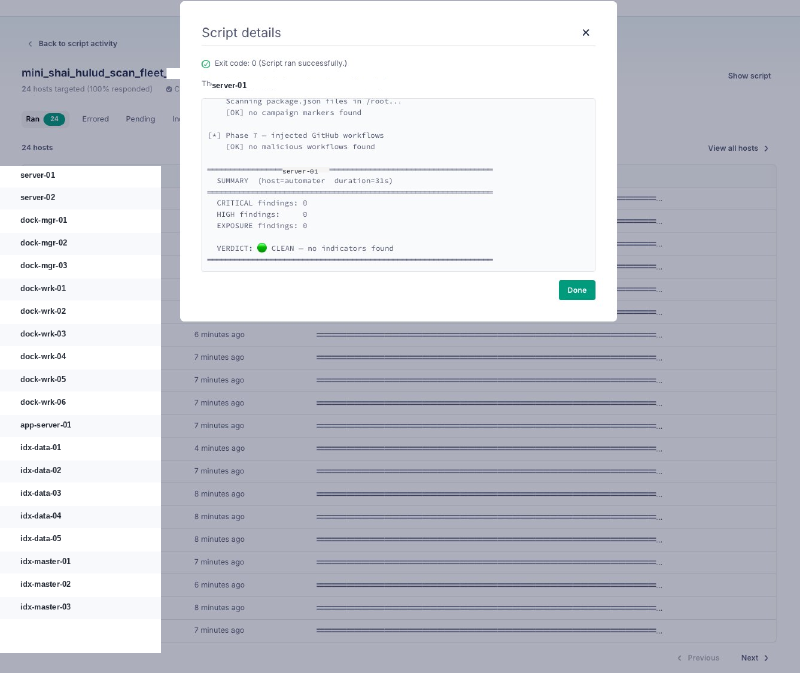
All 24 Linux hosts returned exit 0 — CLEAN. Sample output from one host:
[*] Phase 6 — campaign markers in package.json
    Scanning package.json files in /root...
    [OK] no campaign markers found

[*] Phase 7 — injected GitHub workflows
    [OK] no malicious workflows found

═══════════════════════════════════════════════════════════════
  SUMMARY  (host=automater  duration=31s)
═══════════════════════════════════════════════════════════════
  CRITICAL findings: 0
  HIGH findings:     0
  EXPOSURE findings: 0

  VERDICT: 🟢 CLEAN — no indicators found
Windows — 5 hosts targeted (80% responded, 1 pending):
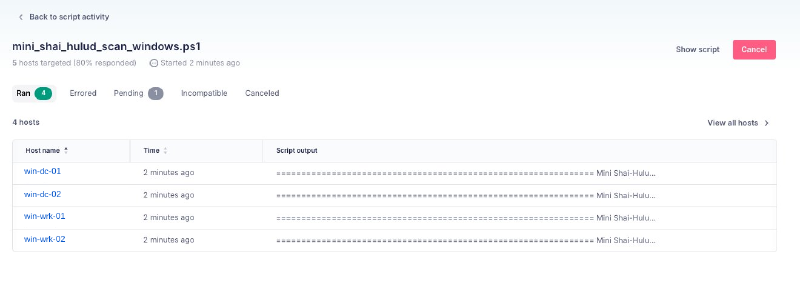
4 Windows hosts ran and returned output. DC01, DC02, WIN10-1, and WRK-AI all completed. One host pending at time of screenshot.
IoC quick reference#
Primary indicators — check these first#
| Indicator | Value / Pattern |
|---|---|
| Malware file | router_init.js (SHA256: ab4fcadaec...601266c) |
| Runner file | tanstack_runner.js (SHA256: 2ec78d5...e27fc96) |
| Forged package | @tanstack/setup — any version is malicious |
| Active process | node process with router_init.js in cmdline |
| C2 egress (confirmed) | filev2.getsession[.]org |
| C2 egress (reported) | api.masscan.cloud, litter.catbox.moe — per Socket.dev, not in official GHSA |
| Spoofed author | claude@users.noreply.github.com |
Persistence locations#
| Platform | Path |
|---|---|
| Linux | ~/.config/systemd/user/gh-token-monitor.service |
| Linux | ~/.local/bin/gh-token-monitor.sh |
| macOS | ~/Library/LaunchAgents/com.user.gh-token-monitor.plist |
| All | ~/.claude/router_runtime.js, ~/.claude/setup.mjs |
| All | ~/.vscode/setup.mjs |
Key compromised package versions (most impactful)#
| Package | Bad versions |
|---|---|
@tanstack/react-router | 1.169.5, 1.169.8 |
@tanstack/router-core | 1.169.5, 1.169.8 |
@tanstack/react-start | 1.167.68, 1.167.71 |
@tanstack/router-plugin | 1.167.38, 1.167.41 |
@mistralai/mistralai | 2.2.2, 2.2.3, 2.2.4 |
@opensearch-project/opensearch | 3.5.3, 3.6.2, 3.7.0, 3.8.0 |
42 TanStack packages directly compromised; the SQL queries also cover the 175-package broader Mini Shai-Hulud campaign since IoCs are shared.
Immediate actions#
Priority 1 — do this now (< 15 min)#
- Block DNS egress to
filev2.getsession[.]organdapi.masscan.cloudat your DNS resolver and firewall. Do this before anything else — cuts exfiltration. - Deploy the SQL queries as Fleet live queries against all endpoints.
- Any host returning CRITICAL (exit code 3, or active process): isolate immediately, then rotate credentials in this order — npm tokens first, GitHub PATs, then AWS/Vault/K8s.
Priority 2 — within 1 hour#
- Deploy the deep scan scripts via Fleet run-script. The SQL queries check global packages; the scripts check every
node_modules/directory on disk. You need both. - Audit git history in any repository for commits from
claude@users.noreply.github.com(confirmed spoofed author) orvoicproducoes(reported compromised account, per Socket.dev). - Check CI/CD workflow files for
toJSON(secrets),getsession.org, orrouter_init.
Priority 3 — within 24 hours#
- Proactive credential rotation on any machine where an affected package was installed in the last 7 days, even if the scan is clean. The malware may have already exfiltrated and cleaned up.
- Audit npm publish logs for unexpected publishes from your organization’s packages.
- Pin GitHub Actions references to commit SHAs.
Key lessons#
Sigstore provenance doesn’t protect you from OIDC token theft. The attacker had a legitimately-issued OIDC token; the signature was valid. Provenance attestations are meaningful for supply chain attribution, not for detecting credential compromise.
Post-install hooks are still the attack surface. postInstall scripts execute with the same privileges as the user running npm install. On developer machines and CI runners, that’s often too much.
Developer tooling directories are high-value targets. The choice to persist in .claude/ specifically shows that attackers track which tools developers use. Directory-based persistence in editor/AI tooling survives across project changes and reboots.
Scan local node_modules/, not just global. Fleet’s npm_packages table is a fast first pass but covers global installs only. Any environment where developers do per-project installs requires a filesystem-level scan to get the full picture.
Rotate first, investigate second. If any affected package version was installed in the last 7 days, assume credentials were harvested and rotate them before spending time on forensics. The window between install and exfiltration is measured in seconds, not minutes.
Resources#
| Resource | Link |
|---|---|
| Socket.dev blog | https://socket.dev/blog/tanstack-npm-packages-compromised-mini-shai-hulud-supply-chain-attack |
| TanStack postmortem | https://tanstack.com/blog/npm-supply-chain-compromise-postmortem |
| Mini Shai-Hulud campaign page | https://socket.dev/supply-chain-attacks/mini-shai-hulud |
| Linux/macOS Fleet SQL | /code/tanstack-linux-queries.sql |
| macOS Fleet SQL | /code/tanstack-macos-queries.sql |
| Windows Fleet SQL | /code/tanstack-windows-queries.sql |
| Linux/macOS deep scan script | /code/mini_shai_hulud_scan_fleet_deep.sh |
| Windows deep scan script | /code/mini_shai_hulud_scan_windows.ps1 |