About karmine
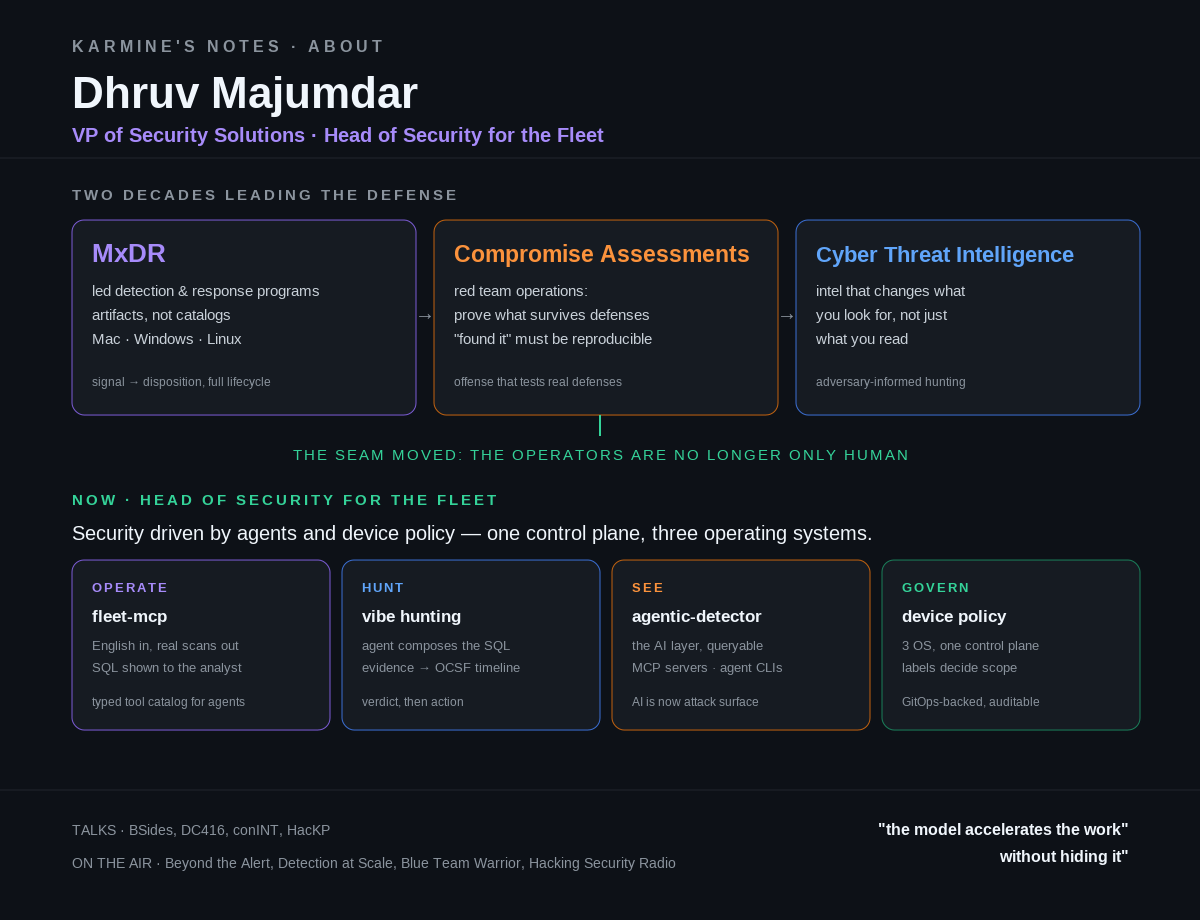
Dhruv Majumdar — VP of Security Solutions, head of security for a mixed-OS fleet. Two decades working in and leading MxDR programs, compromise assessments, and Cyber Threat Intelligence — the programs where the defense has to be reproducible, not just plausible. Now the job is being driven forward by agents and device policy: the operators are human and agent, and the control plane decides what either one may touch.
These notes are the working-out: the tools, the patterns, and the moves that survive contact with real adversaries and real fleets.
Most of what I write touches the seam between detection theory and operational reality — where MxDR programs run on artifacts not catalogs, where vulnerability response works backwards from exploit primitives instead of forwards from a CVE ID, and where a red team’s “found it” only matters if the blue side can reproduce it on every endpoint they own.
The seam has moved again. The operators are no longer only human — agents now sit inside the security stack, and the question is no longer can they help but can their work still be audited. These notes follow agents through that stack: how an agent earns the right to touch a fleet, how its work stays inspectable, and how you keep sight of the AI layer running on your own endpoints. The rule across all of it: the model accelerates the work without hiding it.
The AI-forward bet
Three things I have built and shipped, each an answer to the same question — can an agent do this on my fleet, and can I still audit it?
- Ask, and see the SQL. fleet-mcp turns Fleet into a typed tool catalog any AI agent can call. English in, a real osquery scan across every host you own out — with the SQL and the assumptions shown to the analyst, not buried in a trace.
- Hunt with the agent in the loop. Vibe hunting: state the intent in English, the agent composes the SQL, fuses browser, filesystem and kernel evidence into one OCSF timeline, reaches a verdict, and acts on it. The analyst reviews the timeline, not the tool output.
- See the AI layer you are running. agentic-detector: one osquery table over MCP servers, agent CLIs, IDE plugins, live AI sockets, and the instruction files that tell agents what they are allowed to do. An npx-fetched MCP server with shell-exec capability is now part of your attack surface — so it belongs in your inventory.
The writing runs on a living lab: a mixed-OS estate where agents operate through the same control plane as the humans, and every claim in these notes comes back as a query result rather than a screenshot. Start with one control plane, three operating systems.
What I work on
- MxDR / VMDR and detection engineering — the full lifecycle from signal to disposition, across Mac, Windows, and Linux
- Threat hunting as a craft — artifact-driven, adversarially informed, and reproducible across fleets
- Cyber Threat Intelligence — CTI that changes what you look for, not just what you read
- Red team operations — the offense side, focused on what actually gets past real defenses
- AI for Security Operations — natural-language interfaces over Fleet, osquery, and MCP that make agent output auditable, with SQL still shown to the human analyst
Speaking
I present at security conferences and user groups. Recent stages: BSides, DC416, conINT, HacKP.
On the air
I’ve appeared on several security podcasts over the past year and a half:
- Beyond the Alert — AI agents breaking out of the lab, AI in vulnerability triage, hunting with the model, agentic CTI, agentic SOC, AI supply chain
- Detection at Scale — MDM, device management, and why the endpoint is the new perimeter
- Blue Team Warrior — MxDR in practice, detection engineering, and the operational reality of running a defense
- Hacking Security Radio — a 4-hour deep dive on hunting, CTI, and the MxDR lifecycle
Find me
Opinions are my own.